25 Custom Product Sales Statistics You Should Know in 2026
25 custom product sales statistics for 2026, based on Salsita's research across 600+ companies that sell configurable products. See what slows down quoting, what buyers expect, and what sets the winning manufacturers and retailers apart.
 Camille Felappi
For companies that sell custom products, making the product was never the hard part. The hard part is the stretch between a buyer showing interest and an order getting confirmed: pinning down what they actually want, quoting it manually, confirming the spec over email, and sending a quote days later while the buyer keeps comparing options elsewhere.
The 25 statistics below come from Salsita's 2026 research across more than 600 companies selling furniture, cabinets, windows, doors, railings, outdoor structures, and retail products. They show where companies lose sales, which capabilities they prioritize when looking for a solution, and what separates businesses that still rely on manual processes from those building a more scalable buying experience.
All statistics come from Salsita's 2026 research of 600+ companies that sell custom products.
Custom Product Sales Statistics: the Big Picture
Custom-product buyers now shop the way they shop for everything else online. They open a few tabs, compare two or three suppliers at once, and expect a clear price without a phone call or a week-long wait. What's new is that they bring those habits to complex, made-to-order products, which used to run through sales reps and manual quoting. Most companies selling custom products haven't caught up to that shift, and the gap is exactly where they lose orders.
- 1 in 4 companies (~25%) name quoting or manual-process inefficiency as their single biggest obstacle to closing sales, the most common pain point in the entire study.
- More than 50% want buyers to be able to configure a product and get a price without ever talking to a sales rep.
- More than 50% prioritize the exact same four capabilities to sell more: real-time 3D visualization, visual CPQ, a self-service admin panel, and integrations with their sales and ecommerce systems.
- Around 1 in 10 companies are stuck with a broken or outdated product configurator, meaning the technology meant to speed up selling has become part of the problem.

Sales Process and Quoting Statistics
The bottleneck in a custom sale is rarely the factory. It sits in everything before production: the back-and-forth to work out what the buyer wants, the price manually calculated, the emails to confirm the spec, and the quote that finally lands three days later. For plenty of manufacturers, working out what to build takes longer than actually building it. And the load only grows with the business, because every new order takes the same manual effort as the last.
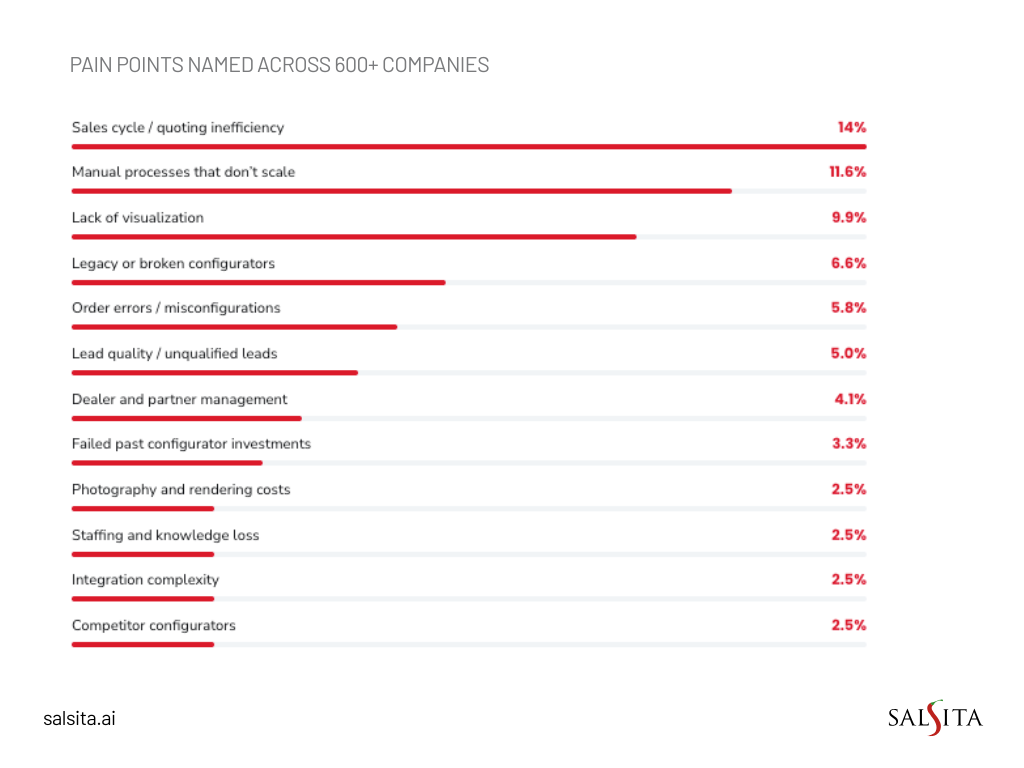
- 14% of companies cite sales-cycle or quoting inefficiency as their main pain point. When a quote takes days, buyers keep shopping, and the fastest supplier to return an accurate quote often wins regardless of product quality.
- 11.6% say their manual sales processes simply don't scale. Every new order takes the same manual effort as the last, so growth becomes a function of headcount rather than capability.
- 5% of companies cite poor lead quality as a pain point. Sales reps spend hours qualifying leads that a 3D product configurator could have filtered automatically.
- 2.5% of companies see staffing and knowledge loss as a direct sales risk. In many firms only a few veterans can price a complex order correctly, and that expertise is rarely written down.
Buyer Behavior and Product Visualization Statistics
Poor visualization leaks revenue in a way that rarely shows up on a P&L. It happens in two connected ways: buyers can't fully picture what they're buying, and the business ends up with wrong finishes, wrong dimensions, and orders that aren't what the customer expected. The two feed each other, because a buyer who can't see the configuration is far more likely to get it wrong. Every one of those misorders carries a return cost, a rework cost, and a damaged relationship.
- 16% of companies name visualization gaps or order errors as a direct problem. When a buyer can't see what they're ordering, the mistake travels into production, where fixing it costs material, machine time, and a delayed delivery.
- 10% say buyers struggle to picture what they're purchasing. A spec sheet and a flat photo leave too much to the imagination, so buyers hesitate, request samples, or drift to a supplier that shows them the finished result in 3D.
- 6% deal with misorders and misconfigurations. This happens when an order reaches production with the wrong options: either a combination that can't actually be built, or one that simply isn't what the customer asked for.
- 2.5% name product photography and rendering costs as a pain point, because shooting every variant of a configurable product is expensive and never complete.
Sales Technology and Configurator Statistics
Having a 3D configurator on the product page doesn't mean the problem is solved. Two situations keep companies stuck: some run a tool their own team can't update without outside help, and others paid for a project that never made it to launch. The outcome is the same either way: the sales process still runs manually.
- 6.6% of companies run a legacy configurator they can't update without a developer. They paid for a tool that no longer does the job it was bought to do. Every price change and new material waits on outside help, so the catalog falls behind.
- 3.3% of companies invested in a configurator that never properly launched. Failed configurator projects are common enough that many companies approach new tools with skepticism.
- 2.5% of companies name integration complexity as a blocker. A configurator only pays for itself when the completed order flows straight into the ERP, CRM, and ecommerce platform behind it.
- 4.1% name dealer and partner management as a pain point. Direct buyers, in-house reps, and dealers each need their own prices and their own view of the product range. Most configurators can't handle all three, so dealers keep ordering by spreadsheet and phone call.
What Makes Companies Invest in a Product Configurator
Most companies live with manual quoting, a visualization gap, or a broken tool for longer than they should. Something specific usually has to force the decision, and more often than not it comes from a competitor. By the time a competitor's configurator is visible enough to notice, they've been winning the easier orders for a while.
- 7.4% of companies say competitive pressure is the trigger that finally makes them act. Once a competitor offers a 3D configurator, a manual quote process feels even more dated by comparison.
- 6.6% of companies point to a new product launch as the moment they build a better sales process. A product launch usually comes with budget, attention, and open decisions about how the product will be shown and priced.
- 5% of companies act after hitting a growth ceiling. They reach the point where selling more would mean hiring more quoting staff rather than earning more margin, and the math finally forces a better way to quote.
- 4.1% of companies make the change during a website redesign. When the site is already being rebuilt, adding a 3D configurator is incremental rather than a standalone project, which lowers the barrier to doing it.
- 3.3% of companies act when an existing sales tool breaks down, loses support, or is discontinued. A tool losing support forces a decision that was easy to postpone.
- 2% of companies cite a business transition, such as new ownership or leadership, as the trigger to overhaul their sales process. New leadership tends to audit inherited workflows. A manual quoting process insiders accepted as normal is often the first thing an outsider questions.
Custom Product Sales Statistics by Industry
The same two problems, quoting and visualization, take a different shape depending on what a company sells. Furniture companies tend to hit configuration fatigue, where too many options overwhelm buyers and they abandon before finishing. Construction products run into the angle question: the non-standard dimensions and structural rules that no dropdown can handle. In ecommerce, the product page is the sales process, so anything a buyer can't see or configure on screen turns into a lost order.
- 30% of furniture companies name manual quoting as their top sales pain point. Sofas, cabinets, and built-ins carry so many size, finish, and material combinations that pricing each order manually becomes the slowest step in the sale.
- 29% of construction-products companies deal with order errors. Angles, non-standard dimensions, load requirements, and structural rules can't be captured by a few simple dropdowns. A spec that reads fine in an email can still be impossible to manufacture.
- 30% of ecommerce companies say static product pages can't show all their variations. One configurable product can hold thousands of variants, and no gallery of flat photos can cover them all, so buyers are left guessing at the exact combination they want.

What the Data Means for Manufacturers and Retailers
Nothing in the data points to production as the bottleneck. It points to everything that happens before an order exists: the quoting, the visualization, and the tools that were supposed to handle both. Here's what that means in practice:
Stop hiring more staff to fix your processes.
If only a handful of people can price a complex order correctly, your sales capacity is capped by those people, and it drops every time one of them is on holiday. The fix is not another hire. It's encoding that knowledge into a system your buyers, your sales team, and your dealers can all use directly, so the next order doesn't cost the same effort as the last one.
If you already have a product configurator, audit it honestly.
Four questions: Can your team update products and pricing without a developer? Does it work on mobile? Do buyers get an accurate 3D visual? Does it connect to your order or production systems? A no on any of those has a real cost attached, and having a tool on the product page doesn't mean the problem is solved.
Remember what the buyer is actually comparing.
When a buyer is looking at your product and a competitor's, they're also comparing the experience of buying it. If your competitor lets them configure and see a price while you send a PDF three days later, that comparison is already happening. It just never shows up in your data.
The window to move first is still open in most industries.
Most companies are still quoting manually. The companies that act now don't just fix a process; they become the easiest company to buy from in their market.
How Salsita Can Help
Salsita builds 3D product configurators and visual CPQ for companies selling parametric, rule-based products: furniture, cabinets, windows, doors, railings, and outdoor structures.
- Real-time 3D visualization, so buyers see the exact configuration they're ordering rather than a flat photo of something close to it.
- Visual CPQ with pricing rules built in, so a quote comes back in seconds instead of days, and impossible combinations are never quoted in the first place.
- A self-service admin panel, so the team can add a material or change a price without booking developer time.
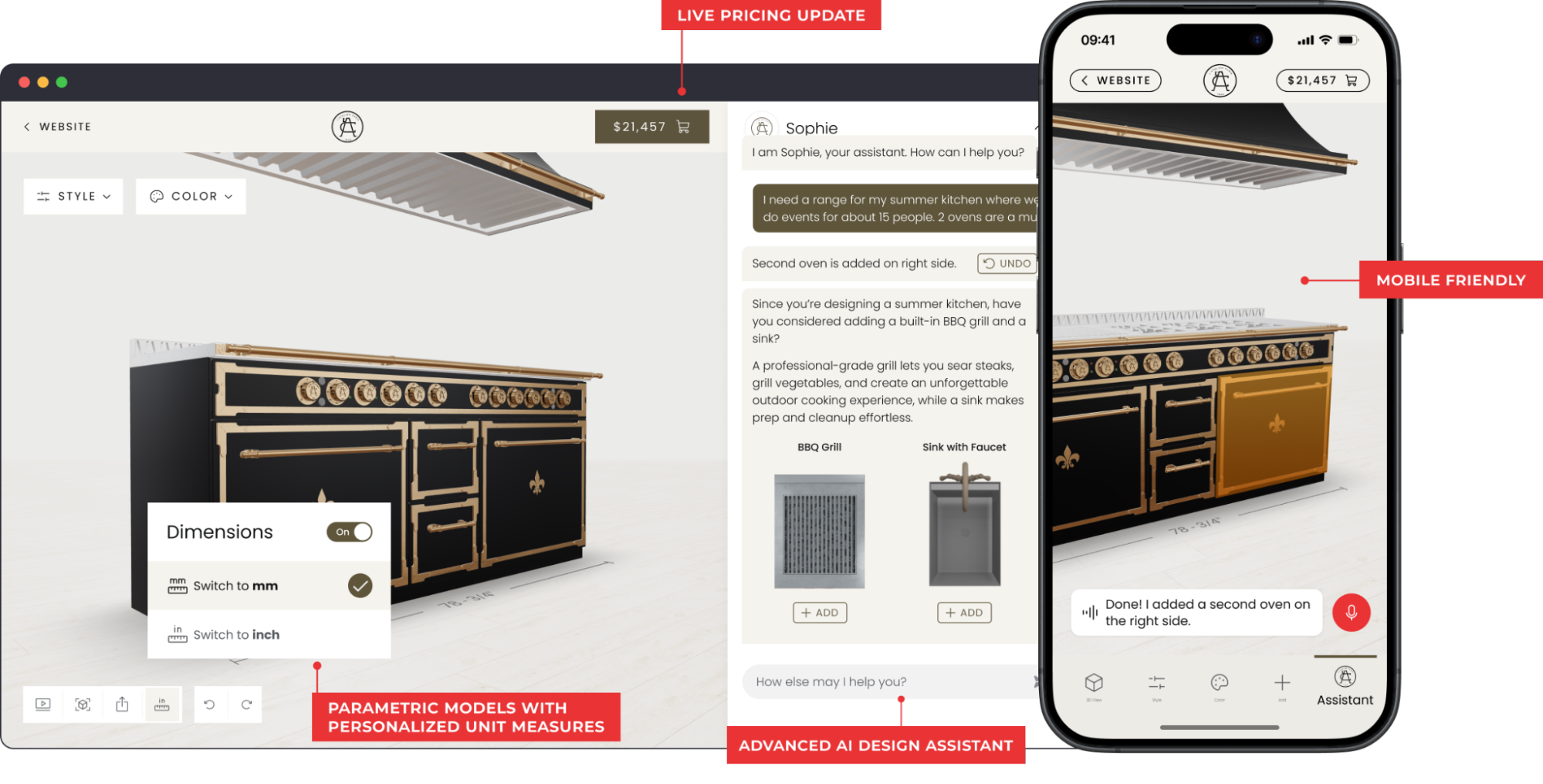
- Advanced AI assistant that recommends and applies changes in natural language, so buyers don't get lost among options.
- Integrations with ERP, CRM, and ecommerce, so the completed order flows straight through without manual re-entry.
- Dealer and partner support, so direct buyers, in-house reps, and dealers each see their own prices and their own product range.
These capabilities close the gap the numbers keep pointing at: the days lost to manual quoting, the orders that reach production wrong, and the tools that need a developer for every price change.
Example of a 3D Furniture Configurator
Want to see how this could work for your products?
Book a demoFAQ
What is the biggest sales challenge for companies selling custom products?
Quoting. Around 25% of the 600+ companies surveyed named quoting or manual-process inefficiency as their single biggest obstacle to closing sales. More than visualization, lead quality, or technology combined.
How many companies want buyers to self-serve without a sales rep?
More than 50% want buyers to be able to configure a product and see a price without contacting a rep.
What causes order errors in custom manufacturing?
Three distinct causes: rules not enforced during configuration (producing combinations that can't be built), buyers who can't see what they selected, and manual re-entry of specs between the quote and the ERP. 6% of companies report misorders and misconfigurations directly; 29% of construction-products companies report order errors.
Which industries struggle most with manual quoting?
Furniture leads: 30% of furniture companies name manual quoting as their top sales pain point, driven by the volume of size, finish, and material combinations. Construction products struggle more with order errors (29%), and ecommerce with static product pages that can't show every variant (30%).
Why do configurator projects fail?
The data shows two failure types. 6.6% of companies run a legacy configurator their own team can't update without a developer, so the catalog falls behind. A further 3.3% paid for a configurator that never properly launched. Both leave the sales process running manually.
What finally makes a company invest in a 3D configurator?
Competitive pressure is the most common trigger (7.4%), followed by a new product launch (6.6%), hitting a growth ceiling (5%), a website redesign (4.1%), a sales tool breaking down (3.3%), and a change of ownership or leadership (2%).
How long does it take to implement a 3D configurator?
Timelines depend on product complexity and integration scope. For parametric, rule-based products, most Salsita deployments go live in about three months from scoping to launch.

Camille Felappi
Camille is a B2B digital marketing specialist, focusing on SEO and content creation. She helps businesses connect with their target audience using data-driven and creative strategies.
Personalized demo with our VP
Stop Losing Deals to Confusing Catalogs
Book a 30-minute call – bring one product, leave with a working 3D configurator prototype and a clear implementation timeline.



Bring one product link – leave with a clear next step.
































Related Articles

Can You Vibe Code a 3D Configurator? We Tested It
Yes, you can vibe code a 3D configurator, but mainly as a prototype. We tested GPT-6 Astra on a real table configurator: here's what AI built well, and where the product logic broke.

What Features Should You Look for in Configurator Software?
Most configurator software evaluations focus on visuals, but ROI comes from the rules engine, pricing logic, and manufacturing outputs. Learn what to test.

7 Best Zakeke Alternatives in 2026
Zakeke is one of the most popular product customization platforms for ecommerce. But popularity does not mean it is the right fit for every business. This guide compares seven alternatives by features, pricing, and trade-offs.