Why Hiring Another Sales Rep Won't Fix Your Railing Order Errors (and What Actually Will)
Railing order errors keep coming back because a single spec gets re-described at every handoff, not because you're short-staffed. See where the errors start, why headcount won't fix them, and how a 3D railing configurator removes them for good.
 Camille Felappi
When railing orders keep coming back with the wrong post type or an angle that doesn't match the site, the first solution that comes to mind is to hire another sales rep to check the specs. It feels like the obvious move.
It usually isn't. The short answer: a new rep adds capacity, not accuracy. Railing order errors don't come from a shortage of people. They come from how many times a single order gets re-described as it travels from the buyer's head to your shop floor. Add a rep and you push more orders through that same path, so you get more orders out, and more errors with them.
It's a common and expensive problem. In our research on selling custom products, order errors from misunderstood specs came up for nearly a third (29%) of the construction companies we talked to, making it the most common accuracy problem in the industry. This article covers where those errors actually start, why headcount doesn't move the number, and what does.
An Order Error is a Translation Error
Take a normal custom order. The customer knows what they want, more or less. They describe it on a call or in an email. A rep writes it up. Someone draws it. An engineer turns the drawing into a CAD file, and that becomes a cut list for the floor.
Each of those steps is one person handing their understanding to the next. The buyer says one thing, the sales rep records something slightly different, the drawing simplifies it, and the part gets made to the drawing. No one did anything wrong, and the railing is still off.
A railing manufacturer we spoke to described it plainly. Orders come in sketched on paper or in an email, go to an engineer to draw up, and "there's a lot of questions back and forth from the engineer because the way people interpret things versus how they draw them don't always add up." The mistake isn't really in any one person. It's in the gap between each of them.
Railings are more exposed to this than most products because the spec is full of numbers and rules that depend on each other: span limits, post spacing, which bracket goes with which profile, what an angle does to the cut. As one manufacturer told us, "it's always the angle question." That knowledge usually isn't written down anywhere. It sits with one or two experienced people and easily gets lost in translation.
Why Hiring More Staff Doesn't Help
A new hire joins the same chain of handoffs. They'll catch some mistakes and make their own, especially early on, because the rules that prevent errors take months to learn and mostly live in other people's heads. You pay for the headcount right away and wait a long time for judgment that may never fully transfer.
This is the staffing risk we kept running into in our research on selling custom products: when the logic for getting an order right lives in people rather than in a system, those people become both a bottleneck and a single point of failure. We also found that 29% of construction companies deal with order errors from misunderstood specs. It's the most common accuracy problem in the category, and adding a person to the chain doesn't touch what's causing it.

One balustrade manufacturer summed up the math while weighing a 3D configurator against a hire: "our other option is that we hire another staff person, which is obviously going to be a lot more than that anyway." The hire costs more and leaves the cause in place.
How Railing Manufacturers Fix Order Errors for Good
The manufacturers who get past order errors for good stop trying to manage the handoffs and remove them instead. They put their whole sales process into one platform: a 3D configurator. The buyer or the rep builds the railing in 3D, sees it updated live, and places the order, with your rules and pricing already built in.
All your product rules sit inside the configurator: which posts work with which infill, the spans and angles you can actually build, and how the price changes with every option. The 3D models live there too, and the order a customer places connects straight through to everything else you run: your website or e-commerce platform, your ERP, CRM, and the STEP files and CNC files the factory builds from.
That gives you a single source of truth for every order, and that is what prevents the errors. A mistake gets in whenever two versions of the same order disagree: the sketch says one angle and the cut list says another. When the order only exists in one place, there's no second version to drift from.
Here's how that plays out at each step that used to go wrong:
| Step in a manual order | Where the error gets in | With a 3D configurator |
|---|---|---|
| Buyer describes the project | Words can't pin down exact sizes and angles | Buyer, sales rep or dealer builds the railing inside the 3D configurator |
| Rep writes up the spec | A second version of the order now exists, and can differ from what was meant | No separate spec; the configuration the buyer approves is the order |
| Engineer sketches it | A third version, drifting further from the first | The 3D model is the drawing, built from the same choices |
| Engineer redraws it for the factory | Another version, re-entered by hand | Cut list and CNC files come straight from that one 3D model |
| Price is worked out separately | The quote can disagree with the final spec | Pricing is part of the same configuration, so it always matches |
A Real Example: AWR's Railing Configurator
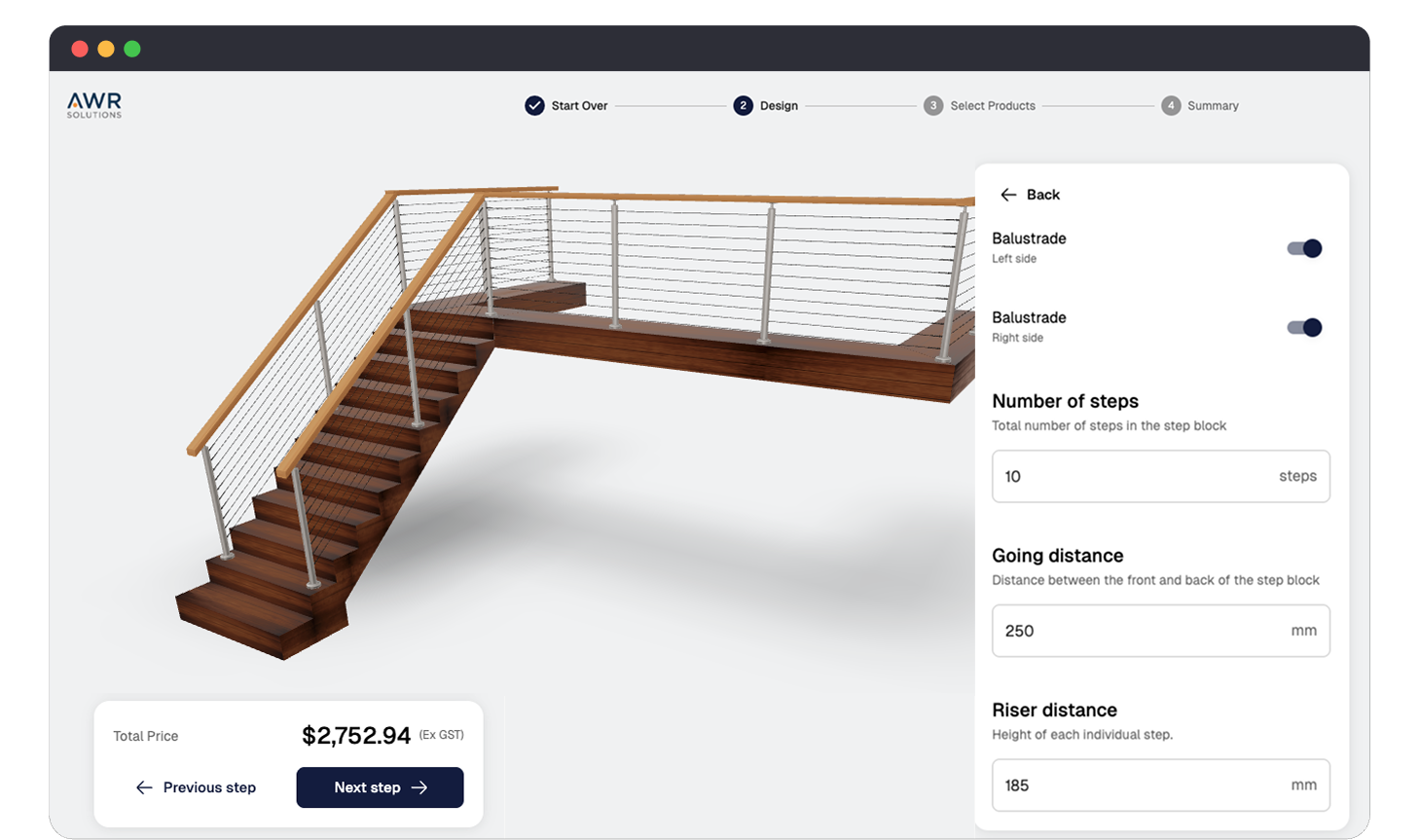
AWR Solutions, an Australian balustrade and railing manufacturer, used to spend days quoting each custom project by hand, quoting every individual component. We built a 3D railing configurator that puts the whole job in one place for them. A buyer or sales rep can:
- Sketch the site layout first (the deck, balcony or stair run) in a couple of minutes, before choosing any railing details
- Add stairs, corners and changes in level, with the angles and connections recalculated automatically.
- Adjust a dimension or angle and let the connected sections update, instead of redrawing the layout.
- Turn the sketch into a 3D model, where the parametric rules take over, with posts, infill, glass and fittings limited to what AWR actually offers.
- Get live pricing and a production-ready cut list, plus CNC files from the same model, with nothing redrawn
The configurator gives AWR one source of truth for every order. Their buyers and reps don't pass an order down a chain to be redrawn. The product rules are built in, so the railing they configure comes out valid automatically, and that same configuration is what gets priced and sent to the factory. With only one version of the order, the errors that come from re-describing and redrawing a spec don't happen.
Want a Railing Configurator to Fix Order Errors? How to Choose the Right Fit
There are two ways to get one: build it yourself, or buy it from a company that already builds them. Building it looks cheaper on paper. But for most railing manufacturers it isn't, and it's worth knowing why before you commit to a direction.
Option 1: Build It In-House
On the surface it looks like a form with a price at the bottom. It isn't.
Underneath, a railing configurator is real-time 3D in the browser: parametric models that hold up across every angle and staircase, a rules engine that blocks what you can't build, live pricing, website and ERP integration, and cut lists and CNC files at the end. That's not one project. It's six, and each one needs talent that's hard to hire and harder to keep.
So most manufacturers take the shortcut: one developer, one build. That's where it breaks. One company we spoke to spent five years and, in their words, "a ton of money" on a custom tool built by a single developer. As they put it, if that one person disappeared, the tool disappeared with them.
Option 2: Buy From a Configurator Company
The other route is to work with a company that builds configurators for a living. Just know that not every product configurator can handle a complex product like railings. Many are simple visualizers, fine for changing a colour or a material but unable to cope with stairs, angles and custom sizing. So when you compare partners, look for:
- Real parametric, made-to-order work: angles, stairs and non-standard sizes, not just colour and material swaps
- A working configurator in your industry you can click through, not a slide deck
- The whole sales process in one tool: 3D, rules, pricing, integration, and production-ready cut lists and CNC files
- A company with support and a roadmap, so the tool never rests on one person
- Integration with the website, e-commerce platform and ERP you already run
Get those right and you have one tool holding one version of every order, which is what keeps railing order errors off the floor. Easysteel is one railing manufacturer that went this way.
See It for Your Own Railings
Book a demo and we'll show you how a 3D railing configurator works, and what one could look like for your products, your rules and your sales process.
Want to see how this could work for your products?
Book a demoFAQ
Will hiring another sales rep reduce railing order errors?
Usually not. A rep adds capacity to handle more orders, but the rate at which orders go out wrong is set by your process, not your headcount. More people feeding the same process means more orders, and more mistakes in absolute terms. Hiring helps with volume, not accuracy.
What causes most custom railing order errors?
Most custom railing spec mistakes come from re-describing the same order too many times. It's spoken, written, drawn, modelled, then cut, and detail slips at each handoff. Railings are especially exposed because the spec depends on interlocking rules like span limits, post spacing, and angles. In our research, order errors from misunderstood specs were the most common accuracy problem named by the construction companies we talked to (29%).
How do you prevent railing spec errors and improve order accuracy?
Cut out the handoffs. Let buyers, sales reps or dealers configure the railing in a 3D configurator and confirm it before ordering; enforce valid dimensions and combinations so an invalid order can't be placed; and generate the cut list, STEP files and CNC output straight from the approved configuration so nothing is redrawn after sign-off. With one version of the order, railing order accuracy stops depending on who happens to be reading the spec.
What is a 3D railing configurator?
It's a single tool where a buyer, rep or dealer builds the railing on screen, choosing posts, infill, glass, spans and angles, with your product rules and pricing built in. The configuration they approve becomes the order, and that same model produces the quote, the cut list and the CNC files for the floor. Because the order lives in one place instead of being redrawn at every step, the translation errors behind most railing spec mistakes don't get a chance to creep in.

Camille Felappi
Camille is a B2B digital marketing specialist, focusing on SEO and content creation. She helps businesses connect with their target audience using data-driven and creative strategies.
Personalized demo with our VP
Stop Losing Deals to Confusing Catalogs
Book a 30-minute call – bring one product, leave with a working 3D configurator prototype and a clear implementation timeline.



Bring one product link – leave with a clear next step.
































Related Articles

7 Best Zakeke Alternatives in 2026
Zakeke is one of the most popular product customization platforms for ecommerce. But popularity does not mean it is the right fit for every business. This guide compares seven alternatives by features, pricing, and trade-offs.

7 Best 3D Configurators for Manufacturing in 2026
We compared 3D configurators for manufacturing based on what actually matters: parametric modeling, multi-user access, ERP connectivity, CPQ, and manufacturing-ready outputs.

25 Custom Product Sales Statistics You Should Know in 2026
25 custom product sales statistics for 2026, based on Salsita's research across 600+ companies that sell configurable products. See what slows down quoting, what buyers expect, and what sets the winning manufacturers and retailers apart.