8 Best Product Configurators for Ecommerce in 2026
We compared product configurators for ecommerce based on what actually matters: 3D visualization quality, configuration depth, ecommerce integration, CPQ capabilities, and long-term business value for online brands.
 Camille Felappi
Choosing the right 3D product configurator for ecommerce is not an easy task. The real question is not just “which one looks best?” It is: how much of your business needs to run through the configurator?
If you sell simple personalized products, a basic ecommerce configurator may be enough. Shoppers choose a color, add text, upload an image, select a few options, and check out. In that case, platforms like Zakeke or Simplio3D can be a good fit.
But if you sell complex, modular, or made-to-order products, the configurator has to do much more. Salsita supports that kind of ecommerce model. Buyers configure in 3D, pricing updates in real time, the product moves to checkout, and the order data connects to the systems behind the business.
In this guide, we compare the best ecommerce product configurator platforms of 2026, from simple personalization tools to advanced 3D configurators built for more complex buying models.
What Makes a Great Ecommerce Product Configurator?
Not every tool calling itself an ecommerce product configurator can handle the complexity that online brands actually face.
We evaluated each ecommerce product configurator based on the criteria that matter most for online brands selling configurable products.
- Configuration Depth: Can the platform handle only simple options, or can it support modular products, custom dimensions, dependencies, compatibility rules, and advanced product logic?
- 3D Visualization: Does the platform help buyers clearly understand what they are configuring? Can they rotate, zoom, view changes in real time, or see the product in context?
- Ecommerce Fit: Does it work well with ecommerce platforms such as Shopify, WooCommerce, Magento, BigCommerce, Salesforce Commerce Cloud, or custom/headless ecommerce systems?
- Ecommerce CPQ: Can pricing update automatically based on product rules, dimensions, materials, components, quantities, discounts, or business logic?
- Checkout and Quote Workflows: Does the configurator support add-to-cart, request-a-quote, dealer handoff, sales-assisted buying, or internal quoting?
- Manufacturing and Order Outputs: Can it generate the data needed after checkout, such as CAD files, BOMs, print-ready files, production summaries, or structured configuration data?
- Long-Term Business Value: Does it support the business as product complexity, sales channels, and operational needs grow?

Best Product Configurators for Ecommerce in 2026: Quick Comparison Table
| Platform | Best For | Configuration Depth | 3D / Visual UX | Ecommerce CPQ | Integrations | Manufacturing Outputs | Main Limitation |
|---|---|---|---|---|---|---|---|
Salsita | Complex, modular, made-to-order ecommerce | Very strong | Very strong | Very strong | Very strong | Very strong | More setup than lightweight customizers |
Zakeke | Simple ecommerce personalization | Basic | Moderate | Moderate | Strong | Limited | Option-based logic only |
Threekit | Enterprise visual commerce | Strong | Very strong | Strong | Strong | Strong | High cost, longer setup |
Expivi | 3D configuration with pricing | Moderate–strong | Strong | Strong | Strong | Moderate | Less flexible for heavy modular logic |
Cylindo | Visual merchandising and product imagery | Basic | Moderate | Moderate | Moderate | Limited | Visualization-first |
Roomle | 3D / AR configuration for retail and home products | Moderate | Strong | Moderate | Moderate | Limited | Less suited to advanced production automation |
Sayduck | Fast, app-less 3D and WebAR for Shopify and BigCommerce | Moderate | Strong | Moderate | Strong | Limited | Not built for complex CPQ or manufacturing pipelines |
Simplio3D | Entry-level 3D configuration testing | Basic | Moderate | Basic–moderate | Moderate | Limited | Basic rendering and scalability limits |
1 - Salsita
Salsita is an end-to-end 3D product configurator for ecommerce brands selling complex, customizable, modular, or made-to-order products. It is built for businesses where product configuration is a core part of the online buying experience, connecting the journey from customer configuration to pricing, checkout, order data, and manufacturing outputs.
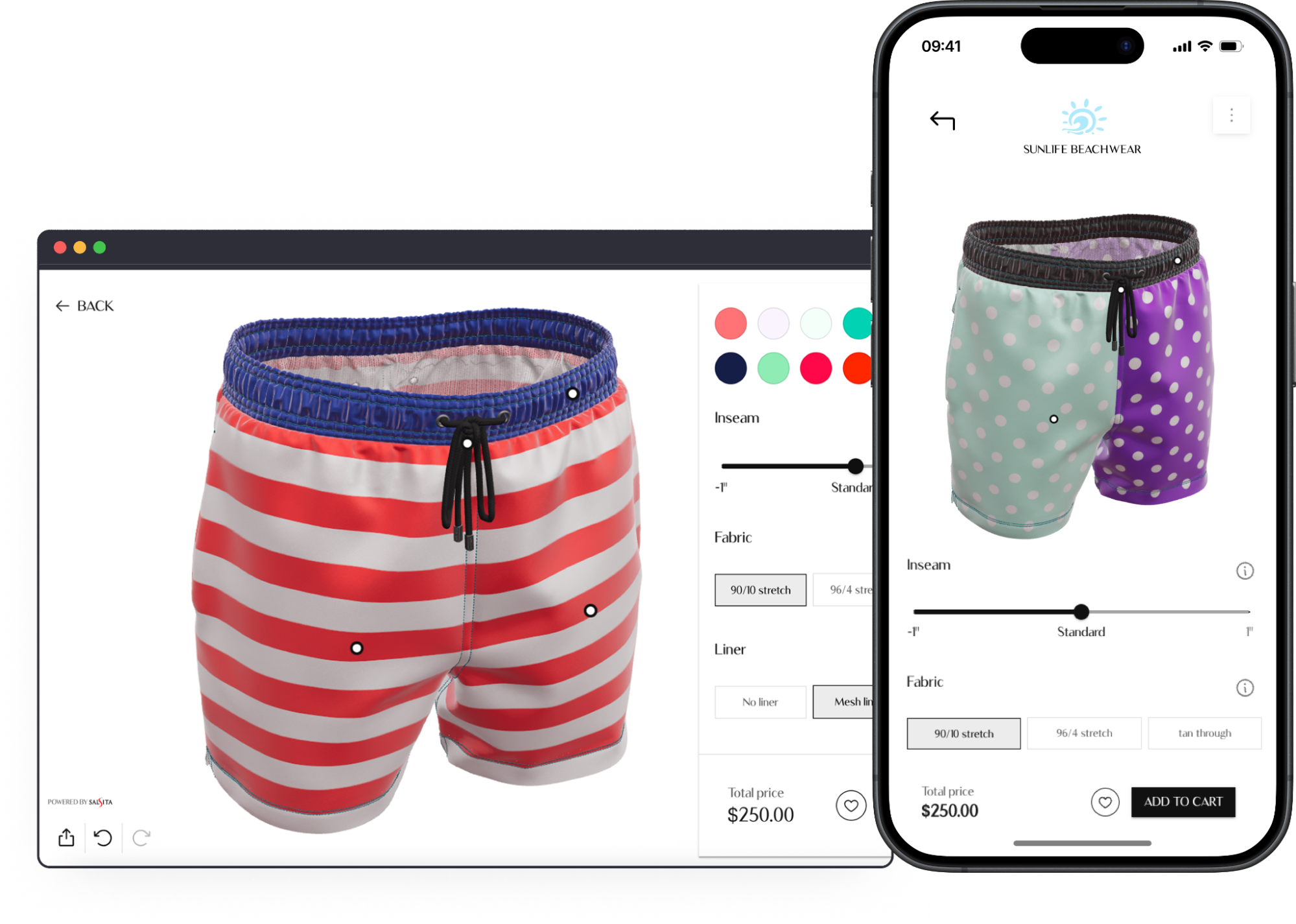
ecommerce brands where product configuration is the business model, not just a feature. Companies selling custom, made-to-order products, requiring design-to-manufacturing automation.
Key Features for Ecommerce Brands:
- Advanced parametric models with high-fidelity 3D visualization
- Visual CPQ for live pricing as products change
- Real-time text and image embroidery
- Advanced AI assistant that recommends and applies changes in natural language
- Ecommerce integration with add-to-cart workflows
- Manufacturing outputs such as BOMs and CAD files
- ERP, CRM, and PIM integrations
- Print-ready files
- AR product previews
Pros
- Strong fit for ecommerce brands where product configuration is central to the buying journey
- Built for complex, modular, and made-to-order products, not just simple personalization
- Parametric models keep custom dimensions, components, and product logic accurate in real time
- Connects 3D visualization, pricing, checkout, order data, and manufacturing outputs
- Advanced AI Assistant can give brands a more differentiated buying experience
- Supports customer-facing ecommerce, dealer, and sales-assisted buying models
Cons
- Requires structured product logic and configuration rules before deployment
- Less suited for brands with very simple product catalogs
Salsita is the best ecommerce product configurator for brands that want configuration to support the full buying model: from 3D product design and real-time pricing to cart, checkout, order data, and production handoff. It is also the strongest Threekit alternative for ecommerce teams that want advanced 3D configuration at a lower price, with a more flexible setup around product logic, integrations, and implementation.
2 - Zakeke
Zakeke is a self-service ecommerce product configurator designed primarily for straightforward product personalization on popular ecommerce platforms.
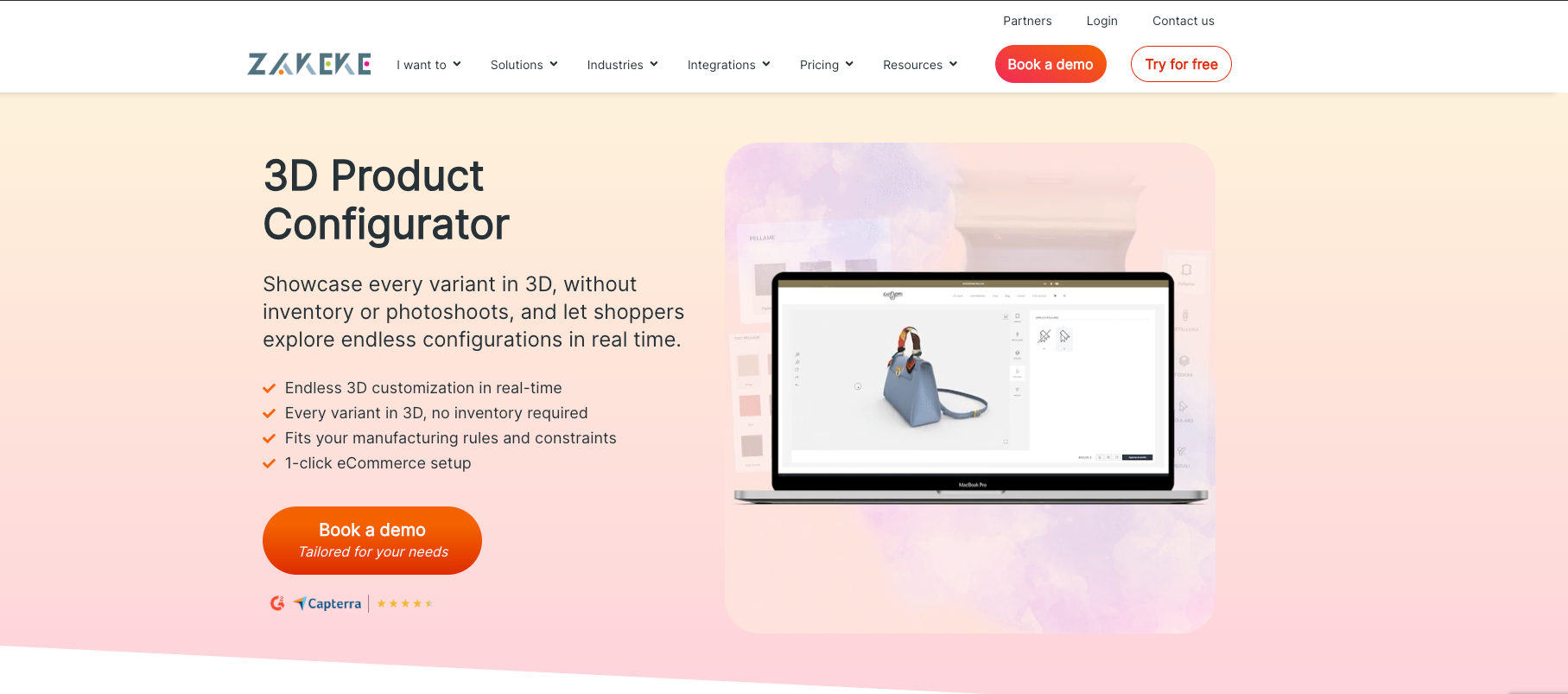
Online retailers selling products with basic customization options (colors, materials, simple add-ons) on Shopify, WooCommerce, or BigCommerce.
Key Features for Ecommerce Brands:
- AR preview capabilities
- Shopify, WooCommerce, and BigCommerce integrations
- Dynamic pricing for product options
- Print-ready files for customized products
- Print-on-demand support
Pros
- Quick deployment for standard ecommerce platforms
- Affordable pricing for SMBs
- Works well for apparel, accessories, and gift products
Cons
- Doesn't support parametric models or structural adjustments beyond basic scaling
- No CAD outputs or advanced manufacturing integration
- Struggles with multi-level product dependencies
Zakeke works well for ecommerce stores selling simple customizable products where customers swap colors, add text, or upload images. But it doesn't support true made-to-order manufacturing. Without CAD outputs, there's no automated path from customer configuration to your manufacturing floor. It is fine for print-on-demand and personalized gifts, but if you're manufacturing custom products to order, you need a platform that generates production files.
3 - Threekit
Threekit is an enterprise-grade visual commerce platform combining 3D configuration, AR experiences, and guided selling workflows.
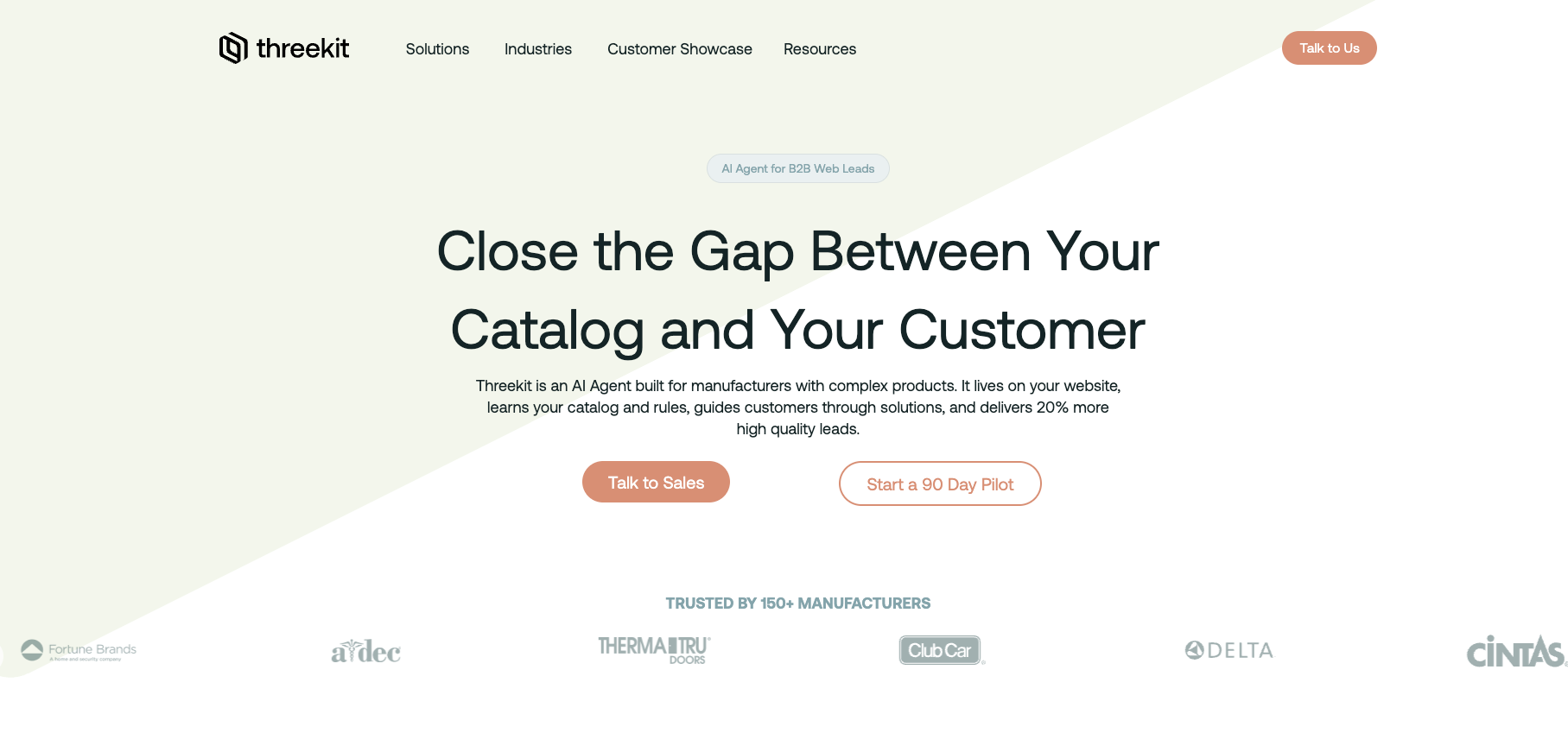
Enterprise brands prioritizing visual product experiences across digital commerce channels with significant budget and implementation resources.
Key Features for Ecommerce Brands:
- Augmented reality (AR) capabilities
- Guided selling workflows
- Instant quoting functionality
- Manufacturing outputs (BOM, CAD)
- Multi-platform integrations
Pros
- Visual quality and rendering
- Handles large SKU counts and complex variants
- Includes manufacturing documentation capabilities
- Enterprise-grade scalability
Cons
- Premium enterprise pricing
- Lengthy implementation timelines
- Less flexible for brands needing rapid iteration
Threekit is a strong enterprise visual commerce platform for brands that need high-quality 3D visualization, guided selling, and scalable product experiences. However, for ecommerce brands that want a similar level of advanced 3D configuration at a lower price, Salsita offers a more flexible and cost-effective alternative, especially for teams that want the configurator to fit tightly around their ecommerce workflow, sales process, and production setup.
4 - Expivi
Expivi offers a 3D product configurator for ecommerce with integrated pricing capabilities designed for mid-market brands.
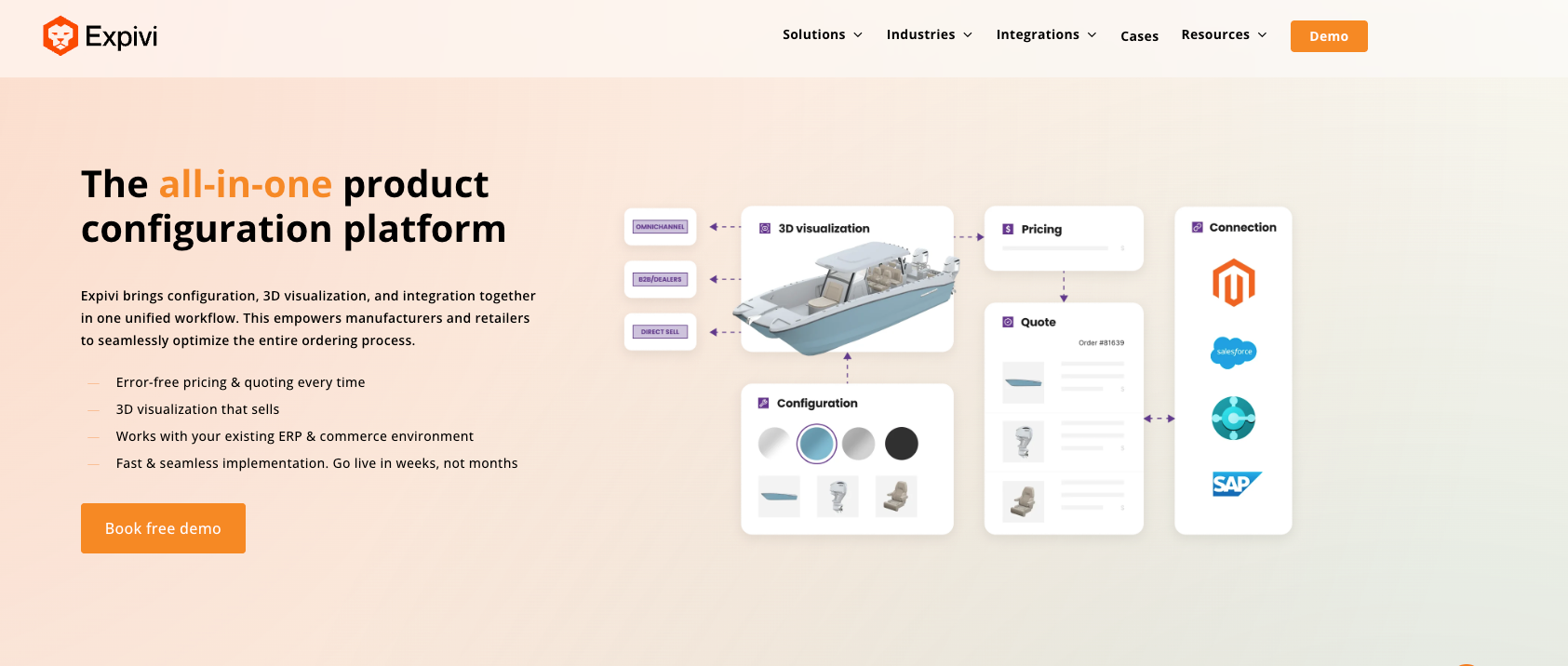
Ecommerce brands selling standardized configurable products that need strong 3D visualization and integrated pricing, but have less advanced parametric, multi-channel, or sales-to-production workflow requirements.
Key Features for Ecommerce Brands:
- Built-in CPQ with dynamic pricing
- Design-to-print functionality
- ecommerce platform integrations
- ERP and PIM integration
- AR visualization
Pros
- Strong ecommerce-led deployment model
- Reasonable pricing for mid-market
- Good for standardized configurable products
Cons
- Limited flexibility for highly complex, rule-heavy product logic
- Parametric modeling is less suited to advanced constraints and dependencies
- CAD file export is not clearly highlighted
- Can become restrictive for highly modular and made-to-order products
Expivi handles ecommerce product configuration well for standardized configurable products. While it includes some manufacturing outputs, they're not as robust as platforms built for engineer-to-order workflows. If your products require extensive parametric modeling or heavy integration with manufacturing systems, Expivi can become restrictive.
5 - Cylindo
Cylindo specializes in high-quality product visualization and digital asset management for ecommerce brands, using pre-rendered imagery rather than real-time configuration.
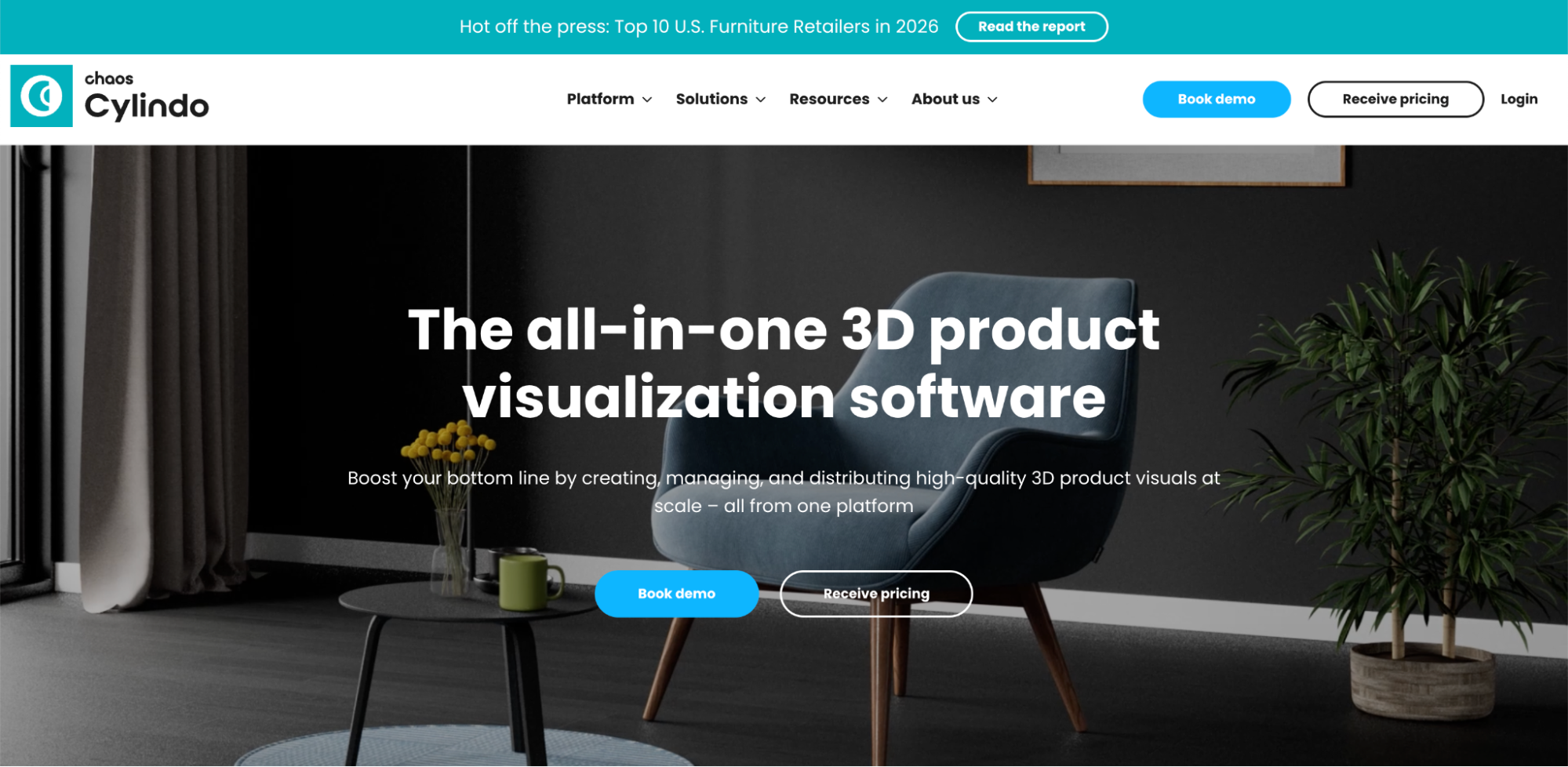
ecommerce brands with standardized product catalogs that need consistent, high-quality product imagery across digital marketing channels.
Key Features for Ecommerce Brands:
- High-quality visualization and rendering
- Digital asset management for product imagery
- AR capabilities
- Integration with ecommerce platforms
- Multi-channel content distribution
Pros
- Strong visual quality for marketing
- Good for standardized product variations
- Consistent imagery across channels
- Strong for fashion and furniture visualization
Cons
- Pre-rendered images rather than real-time 3D modeling
- All configurations must be defined and rendered in advance
- Cannot handle custom dimensions or free modular configuration
- Limited configuration logic for products with many variables
- CAD files and production documentation are not core strengths
Cylindo works well for ecommerce brands selling standardized products with predefined variations, but it's not the best fit for made-to-order businesses. But it is not built to be the operational center of a made-to-order ecommerce model. If pricing, checkout, custom dimensions, production files, or sales-to-manufacturing handoff matter, Cylindo starts to feel more like a visual layer than a true ecommerce product configurator.
6 - Roomle
Roomle is a product configurator for ecommerce brands that want shoppers to view and customize products online. It is often used for furniture, home products, and modular retail products where visual presentation is important.
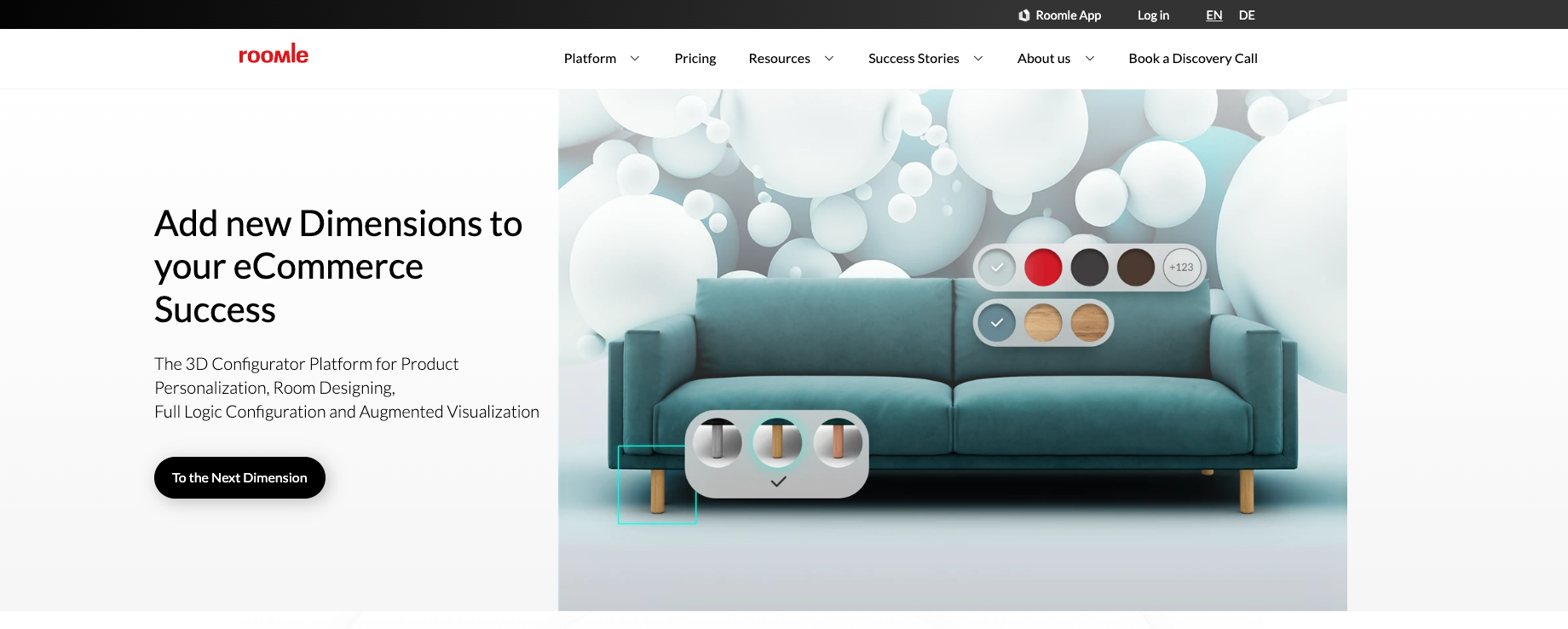
Ecommerce brands that need 3D and AR visualization for configurable products, but do not require advanced sales, pricing, or production workflows.
Key Features for Ecommerce Brands:
- AR product preview
- Ecommerce integrations
- Live pricing support
- Order data and parts lists
Pros
- Good visual experience for ecommerce
- Useful for furniture and home-product configuration
- Supports AR and material changes
- Can connect to ecommerce workflows
Cons
- More focused on visualization than advanced ecommerce CPQ
- Less suited to complex made-to-order products
- Limited fit for custom dimensions, deep product rules, or production automation
Roomle is a solid option for ecommerce brands that mainly need 3D visualization, AR, and product option configuration. It is less compelling for companies where the configurator needs to manage complex product logic, real-time CPQ, direct checkout, ERP integration, and production-ready outputs.
7 - Sayduck
Sayduck is a self-serve 3D product visualization platform for ecommerce brands that want interactive 3D and AR on product pages without a heavy implementation. It focuses on lightweight WebGL viewers built to load fast, with no-code deployment on Shopify, BigCommerce, and custom storefronts.
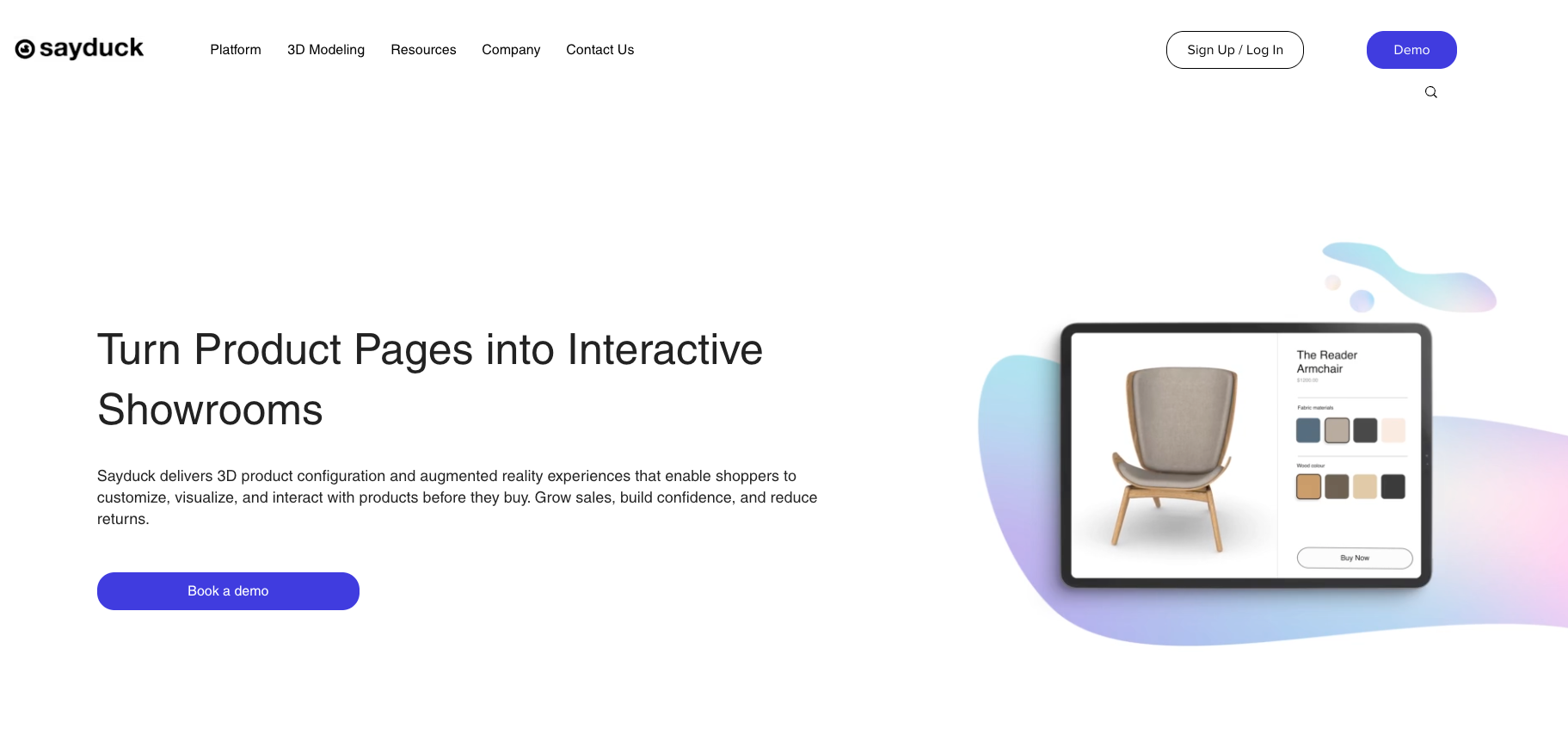
Ecommerce brands that want fast-loading 3D viewers, no-code configurators, and app-less WebAR on product pages, without enterprise CPQ or production requirements.
Key Features for Ecommerce Brands:
- Lightweight WebGL 3D viewers optimized for page speed
- App-less WebAR that runs in any mobile browser
- No-code product configurators
- Shopify, BigCommerce, and custom storefront integrations
- Real-time material and color changes
- Virtual photography for product imagery
Pros
- Fast-loading viewers that do not hurt Core Web Vitals or SEO
- AR works instantly on mobile with no app download
- No-code setup across Shopify, BigCommerce, and custom stacks
- Quick time to launch with no long implementation phase
- Photorealistic material and color changes on any device
- Reduces the need for traditional studio photography
Cons
- Not built for modular products with parametric constraints
- No CAD exports, BOMs, or manufacturing outputs
- Not designed for enterprise CPQ or dealer and sales-assisted workflows
Sayduck is a strong choice for ecommerce brands whose priority is visual quality and page speed rather than configuration depth. It gets interactive 3D and AR live quickly on Shopify or BigCommerce without the load-time penalty of heavier apps. It becomes limiting once configuration needs to handle custom dimensions, deep product rules, real-time CPQ, or production handoff.
8 - Simplio3D
Simplio3D is a self-service, web-based 3D product configurator for teams that want to test interactive product customization without a large implementation. It works for simple products, basic pricing logic, and WooCommerce cart flows, but it is not the right fit for complex configurable products, advanced ecommerce CPQ, or brands that need configuration to connect with manufacturing and business systems.
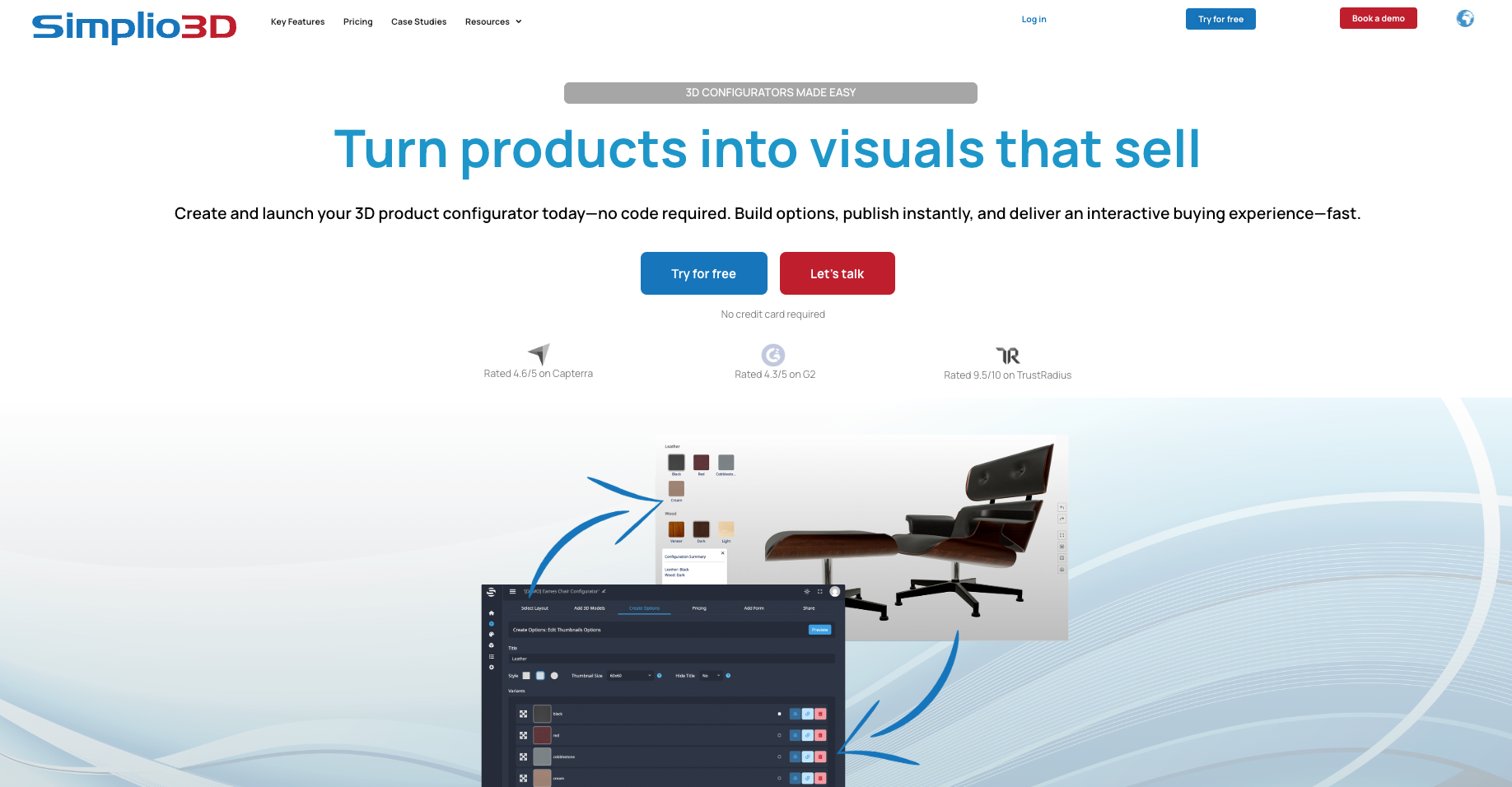
Ecommerce brands testing 3D product configuration for simple products.
Key Features for Ecommerce Brands:
- WooCommerce and WordPress support
- Add-to-cart support for WooCommerce
- Dynamic pricing
- Conditional logic and restrictions
- Ecommerce and API integration options
Pros
- Affordable entry point
- Faster setup than advanced configurator platforms
- Low technical barrier
- Simple admin interface
Cons
- Basic rendering quality
- Limited scalability
- Simple rule engine
- No manufacturing outputs
- Performance issues with complex models
- Entry-level feature set
Simplio3D is a practical entry-level option for ecommerce brands testing 3D configuration, pricing, quote requests, and add-to-cart flows. But it is much more limited once configuration needs to support advanced ecommerce CPQ, complex product logic, CAD exports, CNC-ready outputs, or production handoff.
How to Choose Your Ecommerce Product Configurator
Choosing the right ecommerce product configurator starts with one question: what role should configuration play in your business?
For some brands, the ecommerce configurator only needs to help shoppers personalize a product and add it to cart. For others, it needs to manage the full buying flow, from 3D product configuration and pricing to checkout, order data, integrations, and manufacturing outputs.
Here’s what to check before choosing.
1. Start With Product Complexity
A simple product customizer may work if shoppers only choose colors, text, images, logos, or fixed options.
But if your products involve custom dimensions, modular parts, compatibility rules, materials, components, or made-to-order logic, you need a more advanced 3D product configurator for ecommerce.
- Simple personalization: Zakeke, Simplio3D
- Visual product configuration: Roomle, Cylindo, Sayduck
- Advanced ecommerce product configuration: Salsita, Threekit
2. Check How Your Pricing Works
If every product change affects the price, your configurator needs more than basic option pricing.
For simple products, tools like Zakeke or Simplio3D may be enough if pricing only changes by selected options or add-ons.
For more complex products, look for ecommerce CPQ features that can update pricing based on dimensions, materials, components, quantities, discounts, rules, and dependencies. This is where platforms like Salsita, Threekit, and Expivi are more relevant.
3. Look at Your Checkout Experience
A good ecommerce configurator should make it easy for shoppers to move forward once the product is configured.
Depending on your sales model, that could mean add to cart, direct checkout, request a quote, saved configurations, or dealer and sales-team workflows.
For simple ecommerce stores, Zakeke or Simplio3D can support straightforward cart or personalization flows. For more complex buying journeys, Salsita is stronger when the configured product needs to move from 3D design into pricing, checkout, order data, and connected systems.
4. Understand What Happens After the Order
The best ecommerce configurator is not only about what the buyer sees. It also needs to support what happens after the order is placed.
For simple personalized products, print-ready files or order summaries may be enough. For complex products, you may need CAD files, BOMs, production data, ERP integration, CRM updates, or structured configuration data that your team can actually use.
- Print-ready personalization: Zakeke
- Order summaries and basic configuration data: Simplio3D, Roomle
- Production data and ecommerce-to-manufacturing workflows: Salsita, Threekit
5. Match the Platform to Your Ecommerce Stack
Check whether the configurator works with your current ecommerce setup.
Some platforms are stronger for Shopify, WooCommerce, or BigCommerce. Others are better suited to Magento, Salesforce Commerce Cloud, Shopware, headless ecommerce, or custom systems.
Also look beyond the ecommerce platform itself. If your business depends on ERP, CRM, PIM, or production systems, make sure the configurator can connect to them instead of creating another disconnected workflow.
Wrapping Up: Look Beyond the Product Page
A strong ecommerce configurator should not only help shoppers customize a product. It should also make the next step easier for your business.
For simple products, that may only mean a visual preview and an add-to-cart button. For more complex products, the configurator needs to carry accurate pricing, rules, order data, and production information forward without creating extra manual work.
That is where Salsita 3D Configurator fits best. It is built for ecommerce teams that need configuration to connect the buying experience with the systems and workflows behind it.
Want your buyers to configure, price, and order complex products online, while your teams get the data to move forward?
Want to see how this could work for your products?
Book a demoFAQ
What is a Product Configurator for Ecommerce?
A product configurator for ecommerce lets shoppers customize a product online before buying. Depending on the platform, it can include 3D visualization, option selection, pricing logic, add-to-cart, checkout, quote requests, and order data for fulfillment or production.
What is the Best 3D Product Configurator for Ecommerce?
For simple personalization, tools like Zakeke or Simplio3D can work well. For complex, modular, or made-to-order products, Salsita is the best 3D product configurator for ecommerce because it connects 3D configuration, real-time pricing, ecommerce checkout, integrations, and production-ready outputs.
Do Ecommerce Product Configurators Support Checkout?
Some do. Basic customizers may add personalized products to cart. More advanced ecommerce configurators can support add-to-cart, direct checkout, quote requests, dealer handoff, or sales-assisted workflows. Salsita supports ecommerce workflows where configured products can move directly into cart or order processes.
What is Ecommerce CPQ?
Ecommerce CPQ means configure, price, quote functionality inside an ecommerce buying experience. It allows pricing to update automatically as shoppers change dimensions, materials, components, quantities, or product options. This is important for brands selling complex or made-to-order products online.
Do Ecommerce Configurators Generate Production Files?
Some advanced configurators like Salsita can generate production data such as CAD files, BOMs, print-ready files, order summaries, or structured configuration data. Many lightweight ecommerce customizers only generate visual previews or print-ready artwork, not full manufacturing outputs.

Camille Felappi
Camille is a B2B digital marketing specialist, focusing on SEO and content creation. She helps businesses connect with their target audience using data-driven and creative strategies.
Personalized demo with our VP
Stop Losing Deals to Confusing Catalogs
Book a 30-minute call – bring one product, leave with a working 3D configurator prototype and a clear implementation timeline.



Bring one product link – leave with a clear next step.
































Related Articles

7 Best Zakeke Alternatives in 2026
Zakeke is one of the most popular product customization platforms for ecommerce. But popularity does not mean it is the right fit for every business. This guide compares seven alternatives by features, pricing, and trade-offs.

7 Best 3D Configurators for Manufacturing in 2026
We compared 3D configurators for manufacturing based on what actually matters: parametric modeling, multi-user access, ERP connectivity, CPQ, and manufacturing-ready outputs.

25 Custom Product Sales Statistics You Should Know in 2026
25 custom product sales statistics for 2026, based on Salsita's research across 600+ companies that sell configurable products. See what slows down quoting, what buyers expect, and what sets the winning manufacturers and retailers apart.