









What Is WebMCP? A Practical Guide for Manufacturing Marketers
WebMCP is a proposed browser standard that lets a web page tell an AI agent exactly what it can do there, such as requesting a quote or configuring a product.


WebMCP (Web Model Context Protocol) is a proposed browser standard that lets a web page tell an AI agent exactly what it can do there, such as “request a quote”, “find a dealer” or “configure this product”. Instead of guessing its way through your pages from screenshots, the agent calls those actions directly.
Since August 2026, the browser built into the ChatGPT desktop app can use these tools, and Chrome and Edge are testing WebMCP on real websites. For marketers at manufacturers of complex products, that raises a practical question: when a buyer’s AI agent lands on your quote form or 3D configurator, will it manage to send you the request?
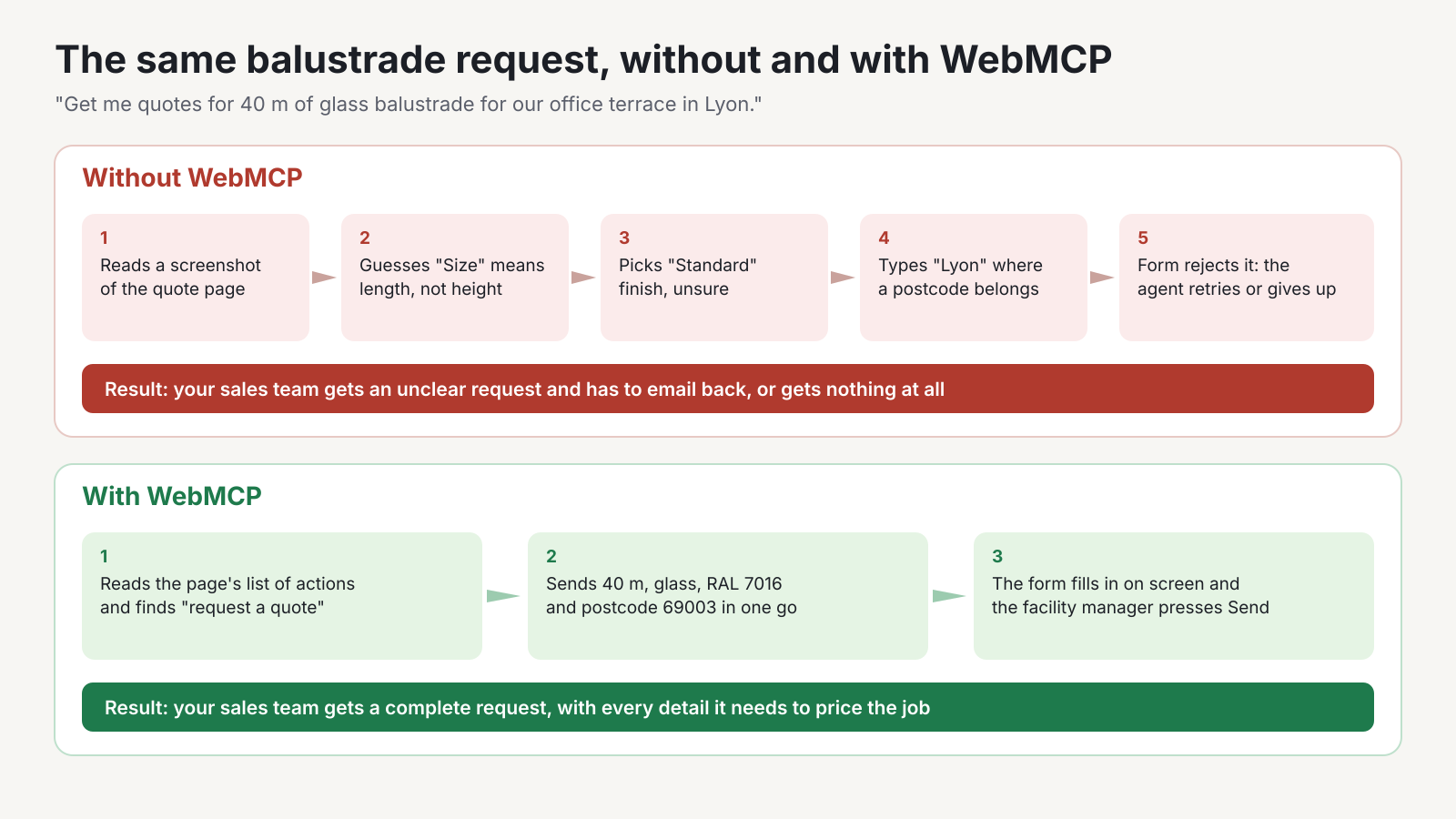
Take a facility manager who types into ChatGPT: “Get me quotes for 40 m of glass balustrade for our office terrace in Lyon, delivered by March.” The agent opens three supplier websites. On two of them, it has to guess what each field means. On the third, the quote form tells it exactly what it needs. Guess which supplier gets the cleanest request.
This guide explains what WebMCP is, what it changes for manufacturers, how it works, and what your marketing team can do about it now.
What Is WebMCP?
WebMCP is a new web standard that lets a website give AI agents a clear list of what they can do on it, like “request a quote” or “find a dealer”, together with exactly what information each action needs.
First, what is an AI agent? It is an AI tool, such as ChatGPT or Claude, that doesn’t just answer questions but also carries out tasks on the web for someone. It opens websites, fills in forms and sends requests. More and more buyers use agents to save time on research and paperwork.
The problem is that websites are made for people, not for agents. When an agent opens your quote form today, it looks at the page much like a person looking at a screenshot. It has to guess what each field means and which button to press. If your form has a field called “Size”, the agent can’t tell whether you mean the length, the height or the glass thickness. A wrong guess means a wrong request, or no request at all.
WebMCP solves this. Your website adds a short description to the form that only agents read. In plain words, it says: “This form requests a quote. It needs the length in meters, between 1 and 120. It needs the type of infill, glass or bars. It needs the delivery postcode.” The agent reads that, fills in the form correctly, and the buyer checks it and presses Send. Human visitors see no difference on the page. The same works on more complex pages: in a 3D configurator, an agent can choose a product’s options while the configurator’s own rules check every choice.
What about MCP? WebMCP is based on MCP (Model Context Protocol), a standard Anthropic introduced in 2024 to connect AI agents to business software such as a CRM. WebMCP applies the same idea to websites. It is still a draft and not yet an official web standard, so browsers are only testing it so far.
Why Does WebMCP Matter for Manufacturing Marketers?
Because the next visitor to your quote form or 3D configurator may be an AI agent, and it will complete the request only where your pages make that easy. Your marketing already works on being found and being mentioned. WebMCP adds a third question: can an agent actually get the job done with you?
| Layer | The question it answers | Manufacturing example |
|---|---|---|
| SEO | Can buyers find us? | Your category page ranks for “glass balustrade system” |
| AI visibility | Do AI answers mention us? | ChatGPT names your brand when asked for balustrade manufacturers in France |
| AI agent readiness | Can an agent complete the task with us? | An agent requests a quote, orders samples or configures a product without anyone clicking |
For manufacturers, the payoff is concrete. Quote requests for complex products often arrive incomplete: no dimensions, no finish, no delivery location, so sales has to email back before anyone can price the job. A request sent through a WebMCP tool arrives with every required field filled in and every value inside the limits you set. That is a shorter path from inquiry to quote, and every campaign you run ends in that inquiry.
The early work costs little. Clear labels, units in every field and limits that match what you produce help human visitors convert today, and they are most of what WebMCP needs later. Manufacturers who made their sites work on phones early avoided a costly rebuild when mobile traffic took over. The same logic applies here.
One expectation to set with your team: OpenAI says it doesn’t connect WebMCP to search rankings, citations or recommendations. WebMCP won’t improve your rankings. It decides whether an agent completes a request with you or with a competitor.
Where Can AI Agents Use WebMCP in a Manufacturing Business?
Anywhere a buyer, dealer or architect does something online: asking for a quote, finding an installer, ordering samples, configuring a product.
In WebMCP, each of these actions is called a tool. A tool is simply one task your page offers to AI agents, with a plain description of what it does and what information it needs. Your quote form can become a tool called “request a quote”. Your dealer finder can become a tool called “find a dealer”. The agent reads the list of tools on the page and uses the one that fits its task.
Here are the tools that matter most for manufacturers:
| Where on the web | Who sends the agent | What the agent can do there |
|---|---|---|
| Quote form | Buyers and dealers | Ask for a price, with product, dimensions, finish and delivery postcode |
| Dealer or installer finder | Buyers | Find certified installers within 50 km of a postcode |
| Sample orders | Architects and buyers | Order three color samples for a facade project |
| Spec sheet and drawing downloads | Architects and specifiers | Download the technical drawing and installation guide for one product |
| Product configurator | Sales reps, dealers and buyers | Build a priced product your factory can make |
| Dealer portal | Dealers | Reorder spare parts from a previous order, after a person confirms |
| Warranty or service form | Buyers and installers | Register a warranty claim with the product’s serial number |
This is not limited to your own website. If your quote form or configurator also appears on a dealer’s or retailer’s website, it can offer the same tools there, as long as that website allows it.
Online shops are moving first. Shopify already offers these tools on every store built with it, so the agents your buyers use are getting used to finding them.
What Does WebMCP Look Like in a Product Configurator?
For manufacturers who sell configurable products, the 3D configurator is where WebMCP can save the most time, because that is where a request takes the longest to turn into a price. At Salsita, our 3D configurators already let AI agents work inside them through WebMCP, a setup you could call a configurator MCP.
Here is the kind of request it handles. A homeowner emails a pergola manufacturer. They want a pergola on the terrace for evening dinners, attach a photo of the house and a hand-drawn plan, and ask for a black frame, warm lights and an outlet. Today, a sales rep reads the email, opens the configurator, rebuilds the design from the sketch, checks the options and writes back with a price. With a few of those a day, it adds up to hours.
With an agent in the configurator, the rep gives an AI agent a single instruction instead: handle this inquiry. The agent then works in the configurator on its own:
- It reads the email, the photo and the plan, and chooses a layout with three bays.
- It adds the bays in the configurator, without anyone clicking.
- It sets the colors, screens and lights. The configurator checks each change, just as it would check a click.
- It drafts a reply to the homeowner that includes the configured price.
- When asked, it places the pergola into the homeowner’s photo of the house, so the reply shows how it could look.
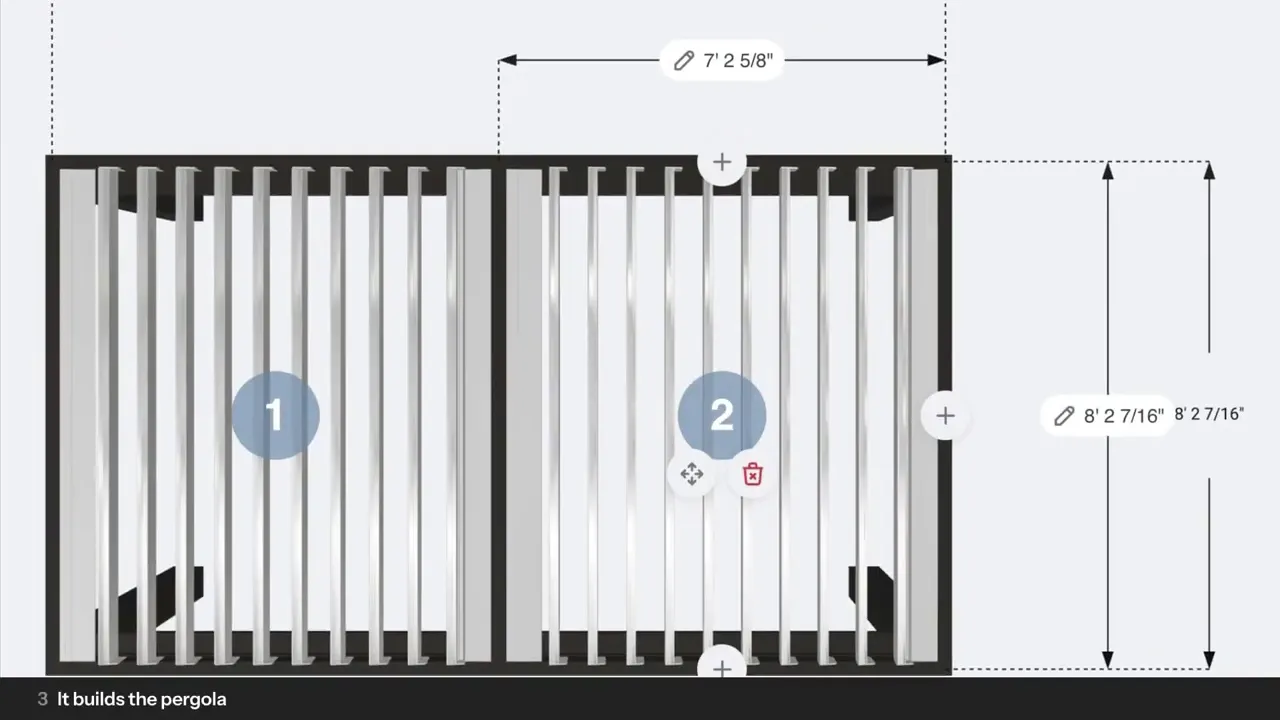
You can trust the result because the agent never edits the 3D model or the prices directly. It uses the same functions as a click, so the product rules check every change and visual CPQ builds the price from the manufacturer’s own price list.
There are limits, though. A person still reads and sends the reply, and the agent has to support WebMCP, which Salsita doesn’t provide. Buyers without an agent can use the configurator’s built-in AI assistant instead, within the same rules.
How Do You Add WebMCP to a Website?
There are two ways, and both are small jobs for your web team. A simple form, such as a quote request, needs two extra attributes in its HTML. An interactive page, such as a dealer locator or a configurator, needs a short script that registers the tool. Browsers without WebMCP ignore the extra attributes, so nothing changes for other visitors.
On the balustrade quote form, the two lines that matter are toolname and tooldescription:
<form toolname="request_quote"
      tooldescription="Request a price quote for a glass or bar balustrade."
      action="/quote">
  <label for="length">Total length (m)</label>
  <input id="length" name="length_m" type="number" min="1" max="120" required>
  <!-- the other fields stay as they are -->
</form>
Marketing’s part is the wording. Chrome’s WebMCP best practices are written for developers, but much of the advice comes down to clear names and plain descriptions:
- One tool, one job.
request_quoteandorder_samplesare separate tools, because overlapping tools confuse the agent. - Use your buyers’ words. “Total length in meters” beats “Dimension A”.
- Make errors useful. “Maximum 120 m per request; contact sales for larger projects” lets the agent recover. “Invalid input” doesn’t.
For the technical details, send your web team Chrome’s Declarative API guide and the WebMCP draft.
What Should Manufacturing Marketers Do Now?
Check how AI answers describe you, audit the actions buyers take on your site, and get your team on the same page. Most of this work helps human visitors too, whatever happens to WebMCP.
1. Check How AI Answers Describe You
An agent can only use your quote form if it finds you first. Ask ChatGPT, Gemini and Perplexity the questions your buyers ask, such as “Which manufacturers make glass balustrades for commercial terraces in France?”, and note:
- whether your brand is named, and which competitors are
- whether the product facts are right: dimensions, finishes, certifications
- which of your pages the answers link to
That gives you a baseline to measure against later.
2. Audit the Actions Your Buyers Take
Pick the five to ten online actions that matter most to sales: the quote request, the dealer finder, sample orders, spec sheet downloads, or the configurator. For each one, check that:
- every field has a clear label with its unit (“Total length (m)”, not “Size”)
- input limits match what you actually manufacture
- error messages tell the buyer how to fix the problem
- the form behaves the same way every time, on every device
Once the forms are in shape, a first WebMCP test takes five steps:
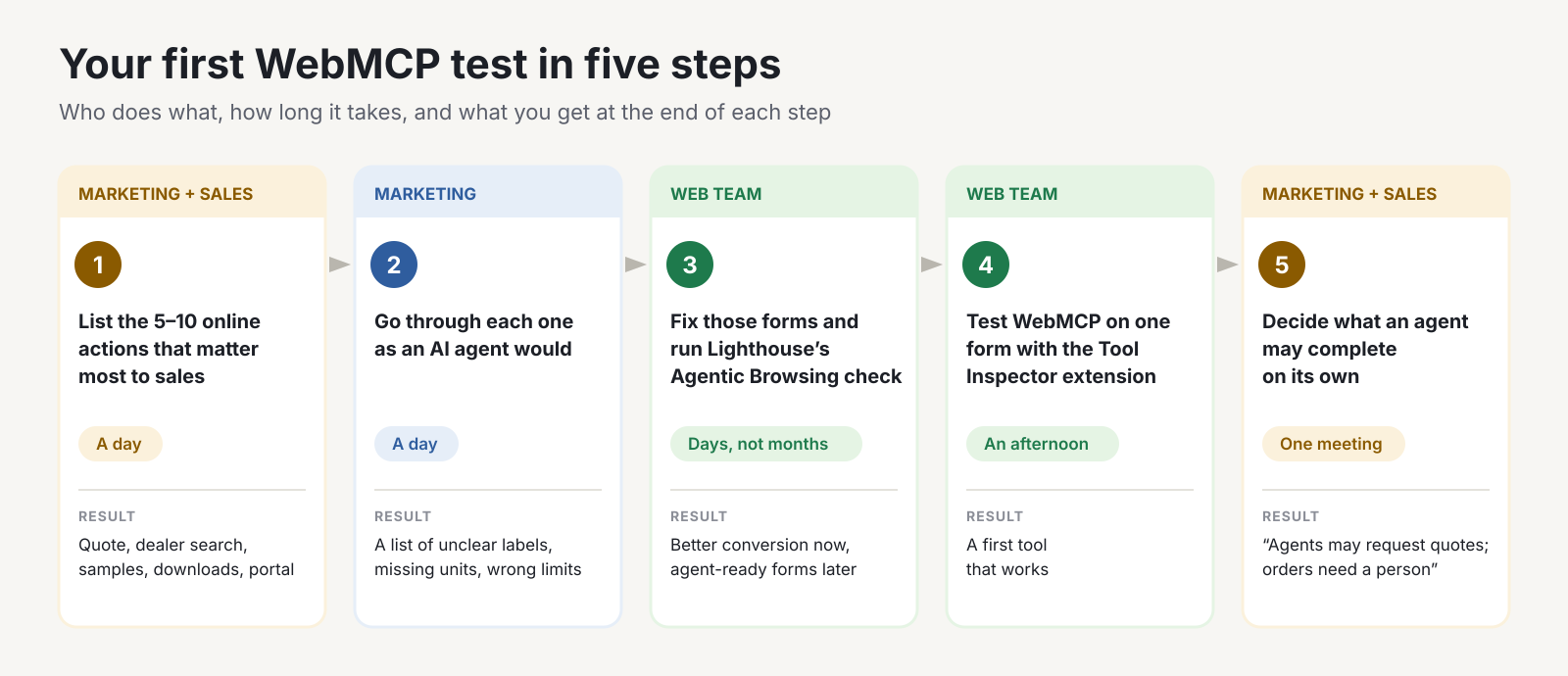
For steps 3 and 4, point your web team to Lighthouse’s Agentic Browsing check and the Model Context Tool Inspector extension.
3. Get Your Team on the Same Page
Present WebMCP as something to watch and test. Each group needs a different message:
- Web team: share Chrome’s Declarative API guide and ask for one test form.
- Sales: agree on what an agent may complete on its own, for example “agents may request quotes; orders need a person”.
- Management: explain that the standard is still uncertain, and that the form work pays off now through better conversion.
Someone will also ask whether an agent could do something you don’t want. The risk is small. An agent can only use the actions your page offers, and by default a person still has to press Submit on a form. Actions that place an order or change data can also be flagged, so the agent checks with the person before it goes ahead.
How We Use WebMCP at Salsita
We build 3D configurators for manufacturers with complex and modular products, and we use WebMCP so AI agents can work inside them without going around the product rules.
More than 200 Salsita configurators are live, and our customers include Siemens and Middleby. The Configurator AI Hub brings all the AI features together:
- AI assistant: customers describe, sketch, photograph or draw what they want, and the configurator builds it.
- AI product preview: one click puts the configured product in a room.
- AI agents: an agent works inside the configurator’s own rules and prices, and every change passes the same checks as a click.
- AI toolkit: your coding agent builds the configurator on Salsita’s platform.
Selling configurable products and want to see an AI agent configure yours? In a 30-minute call, we show you the AI features on a real configurator and answer your questions.
Want to see how this could work for your products?
Book a demoFAQ
What is WebMCP in simple terms?
WebMCP is a proposed browser standard that lets a web page list the actions an AI agent can take there, such as requesting a quote, with clear inputs. The agent uses those actions directly instead of clicking through the page. It is still a draft and in testing.
Is WebMCP the same as MCP?
No. MCP connects an AI agent to business software, such as a CRM, in the background. WebMCP works in the browser: the web page offers its own actions to the agent while the person sees the same page. For marketers, WebMCP is the one that affects how buyers and dealers reach you online.
Does WebMCP replace SEO?
No. An agent has to find you before it can use your quote form, so SEO and AI visibility still come first. OpenAI says it doesn’t connect WebMCP to search rankings, citations or recommendations.
Does WebMCP only work on our own website?
No. It works on any web page or web app that offers tools: your website, a dealer portal, a quote tool, or a form or configurator embedded on a dealer’s or retailer’s site, if that site allows it.
Which browsers support WebMCP?
Chrome tests WebMCP in an origin trial that started in version 149 and now runs until version 162, expected in early 2027. Edge runs a trial from version 150. The built-in browser of the ChatGPT desktop app supports it. Firefox and Safari have no implementation as of November 2026.
Do we need developers to add WebMCP?
Yes, but less than you might think. For forms, a web developer adds two attributes to the existing form. Interactive tools such as dealer locators or configurators need more development. Marketing’s part is choosing the actions and describing them clearly.
Should we add WebMCP now?
Only as a small test. What pays off now is making your key forms clear and well labeled, because those same forms become WebMCP tools with two attributes later.